Southland Ecological Restoration Network

Southland Ecological Restoration Network

A Network of Southland Community Conservation Projects

  • Home
  • Project Directory
  • Organisations
  • Events
  • News
  • About
  • Links
  • Contact

Events

July • Sherwood Forest

Past events

SERN Bringing Back the Birds Conference on Stewart Island

16 – 18 April 2010

Despite very rough ferry crossings, from Bluff to Oban and return, over 50 enthusiastic attendees enjoyed a stimulating and enlightening weekend, hearing about conservation projects on Stewart Island and from other parts of New Zealand, where the main focus is to return our native bird species to greater numbers. Just walking to the backpackers on that first night with the sound of kaka screeching and later moorpork and weka calling highlighted the special character of an area free of stoats and other mustelids.

The field trip to Ulva Island where pests are totally controlled showed the opportunity that arises to bring back birds like the robin, rifleman and saddleback. The increase in quantity and diversity of forest floor vegetation was significant following the eradication of rats.

With SIRCET (Stewart Island/Rakiura Community Environment Trust), intensive trapping of rats and possums on the Ackers Peninsula has lead to increased success of titi and little blue penguin breeding. Check out the ongoing work at www.sircet.org.nz

A visit to the Dancing Star Foundation ‘predator exclusion’ fence, across the peninsula east of the beginning of the Rakiura Track, showed the commitment by this group to creating a pest free area to enable the native birds to thrive.

Similarly we heard about the Orokonui Sanctuary, another ‘predator exclusion’ fenced area, which can be found near Waitati, just north of Dunedin. The group there has also set up an information centre and cafe, which is helping to bring in the wider public - well worth a visit. www.orokonui.org.nz

From the far north, the Whangarei Heads Forum is working to enhance kiwi populations in the area. With a number of Landcare Groups undertaking trapping and the erection of a ‘predator exclusion’ fenced kiwi nursery, the numbers of kiwi are on the increase and can be found across farms or seen even along the sides of the roads. In fact kiwi road signs are not joking - due care has to be taken when driving at night. www.savethekiwi.org.nz/kiwi-saving-kiwi/whangarei-heads.html

In the Firth of Thames, thousands of godwit return each year and there a restoration project is focussing on the catchments that feed the Thames estuary with increasing sediment load being a concern. The western edge is lined with a kilometre wide strip of mangrove swamp, which provides habitat for a wide variety of birds. The Muddy Feet project has been through the planning stage and is now looking at implementing on the ground action with plantings and fencing to reduce the movement of soil off farms and into the waterways. Ecotourism is another challenge facing this area, with sometimes up to 80 campervans parked along the shell banks that birds would otherwise roost on. Looking at education to promote wise use of the area is high on the agenda. www.arc.govt.nz/environment/coastal-and-marine/hauraki-gulf-forum/muddy-feet-project.cfm

In Canterbury, two projects are ongoing. The one is the reintroduction of tui on to Banks Peninsula. With the loss of forest remnants across the Canterbury Plains the return of the iconic tui from the forest of the Canterbury foothills to the Peninsula where predators had wiped it out, was not going to happen. So the helping hand of the Banks Peninsula Trust has translocated a number of tui to Hinewai, the regenerating forest under the guardianship of Hugh Wilson and his able team. These birds have bred this past season and more have been introduced to the area this season. www.bpct.org.nz

Further north on the steep slopes of the Kaikoura Mountains is the Hutton’s Shearwater. Reduced from 8 colonies about 10 years ago, there are only two remaining. The fear that predators or earth movements could decimate these final two colonies has led to the creation of nestboxes around the Kaikoura headland, with the translocation of young into these with the hope that they may return as adult birds in 6 or 7 years time and set up a breeding colony there, in a predator free zone. www.huttonsshearwater.org.nz

Closer to home, Viv Shaw of the Pomona Island project, talked about the great community buy in they had in the Te Anau/Manapouri area to restore this large island in Manapouri. With the removal of 5 pest species since 2005, they had been able to start reintroducing birds, including robin which were breeding well. Recent minor reinvasion by mice meant they had to be vigilant in maintaining traps, however the bird life was much increased due to their efforts. www.pomona-island.org.nz

Ros Cole, Biodiversity Manager, DOC, outlined the requirements for community groups considering translocation of species. The level of predators and habitat suitability were two of the main issues when considering bird reintroductions.

The Saturday night speaker, Brent Beavan from DOC, outlined his observations from a study of community conservation groups throughout NZ and what made them successful. Good communication between community groups and agency staff was an essential part, and developing a relationship with individuals in organisations. Recognition of the skills and value volunteers brought to conservation projects was important.

Colin Meurk, NZBRN (Biodiversity Recording Network) outlined the website where anyone can record their observations of birds, lizards, plants, fish, etc, to build up a picture of NZ’s natural history. For restoration groups this site could be useful as a data base to build up a picture of their project over time - for example bird and pest animal numbers and species. Check it out at www.nzbrn.org.nz.

Our thanks go to the sponsors of the event – Community Trust of Southland, Environment Southland, DOC, Landcare Trust/Biodiversity Southland,Invercargill City Council, Southland District Council and Forest & Bird Southland.

With over 30 volunteers from 15 Southland restoration groups present, there was a sense of renewed energy after a weekend of stimulating discussion and networking with peers. Thanks to Stewart Island and its residents for providing an inspiring setting, warm hospitality and sumptuous catering for the conference, and to all the attendees for their enthusiasm and appreciation for the networking opportunity.

Saturday morning speakers from Canterbury, Northland, Waikato, Southland and Otago.
Field trip to Ulva Island.
Brent Beaven, DOC, speaks on bird reintroductions on Ulva.
Wayne McCallum, Canterbury Biodiversity Co-ordinator, entices a robin by disturbing the leaf litter.
Weka were present on most of the beaches visited.jc.
Sirocco, the kakapo, resides in this pen on his promotional visits to the island, raising the profile of his kind and the work of the Ulva Island Trust.
The relaxed demeanour of this kereru reflects the habit of all the birds on Ulva, in a habitat free of predators.
Claire explains the work of SIRCET at Ackers Point, Sunday morning.
Weeding native plantings undertaken by SIRCET where exotic trees had been removed by SDC.
Dancing Star Foundation (DSF) field trip, Sunday afternoon.
Kari Beaven speaks on DSF.jc.
DSF predator fence, with double secured gate entrance.
Looking at the difference in regeneration behind predator fence as compared to outside where deer are found.
The DSF predator fence where it meets the shore front at Lee Bay.

Walk to Aparima Hut

21 February 2010

Natural History Field Club trip to Aparima Hut - Full day walk. Natural History Field Club trip to Aparima Hut - Full day walk - Leader Lloyd Esler - contact Lloyd 2130404 for details. The Southland Natural History Field Club holds talks and trips every month. Joining fee is $20 contact Phil Rhodes 2144936 or Lloyd to join and receive the monthly newsletter.

SERN Spring Field day 2009 - Invercargill & Environs

7 November 2009

A trip to explore three wetland areas - two created and one restored. A turn out of almost 30 people enjoyed a look at McNeill’s Waldon Pond, east of Invercargill. It wasimpressive to see a brod of 7 scaup recently hatched showing that you create habitat and wildlife comes. The McNeill’s have put many hours into native plantings around their pond and 7ha property, starting in 2003 with basic shelter provided by gums and pines. Ribbonwod and kohuhu planted soon after are now over 3m high. Bob continues an annual planting programme, now planting in amongst the older trees which provide good shelter. At Rance’s property on Grant Rd it was interesting to compare the original pond bult in 1998 with the recent addition of 2005. With the second pond not holding water so well, it has created a different kind of wetland, with more rushy edges enjoyed by wading birds. The final stop at the Southern Wetland Trust’s Big Lagoon at Taramoa gave the group the opportunity to enjoy the large body of water, now restored to even beyond it’s original extent. As well as the main lagoon, Tony has had a number of smaller ponds excavated to the east and south, which provide good nesting and brood rearing areas for the waterfowl. Following a walk around the periphery of Big Lagoon visitors were able to view the unique collection of decoys that Tony has collected, along with the Australian waterfowl display of birds that have been seen on more than one occasion on the lagoon, having been blown over to NZ at different times.

Southland Forest and Bird Trip to hidden treasures around Invercargill

14 March 2009

Visit Kerrs Bush (Myross Bush) and then Judith Robinsons Korimako restoration project and peace garden. Leave Invercargill Museum at 9am or meet at Kerrs Bush at 9.30am. Weeding in the bush until 11.30am. Leaving to have lunch at Judith’s Korimako Property (183 Findlay Road). Bring along appropriate outdoor clothing and boots, gloves for weeding, your own lunch and spades to help plant the native plants we will be donating to Judith. For more details phone Chris Rance (2131161).

Kerrs Bush Update
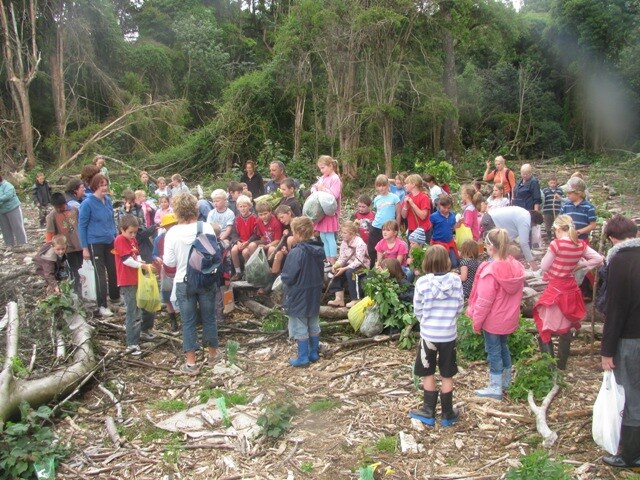
In October 2008 the Landcare group planted 200 trees and the Myross Bush school children planted another 200 native trees including Pittosporum, marble leaf , coprosma, wineberry, narrow leaved mahoe, totara, manuka,koromiko hebe. The whole school revisited the bush in February this year to do some maintenance on their trees, weeding, staking, renaming and measuring. The school intend to revisit the bush each term. Plans are underway for replanting another 400 native trees in spring.

There is a Working Bee on Sat 14th March 9.30 - 11.30am to continue removing sycamore, chilean flame creeper, elberberry, holly and blackberry. Work by Derek has continued to get rid of the parent sycamore trees. Progress is very positive. Mr Begg the landowner, who recently visited was very pleased with the work done and felt very positive about the project. Plans to subdivide his property with 4 building sites beside the Private Scenic Reserve were underway. Any keen, bush loving, potential land owners who would like to purchase and have your own piece of paradise, then this is the spot for you.
Barbara Caughey [[Enable JavaScript to view protected content]]

Judith Robinsons Korimako property and garden is a haven for peaceful reflection and relaxation. There is something for everyone – tranquil sheltered gardens, permaculture gardens with fruit and vegetables galore, chickens, native area. All achieved by Judiths vision and a lot of hard work. We help Judith with any tasks she requires as well as planting native plants to enhance the “forest in the making”.

Unfortunately the visit to Sherry Elton’s cheese farm had to be postponed due to Sherry and Geoff being away – next time perhaps!

Gathering sycamores!
Kerrs Bush 2009 school visit.
Kerrs Bush 09.
Kerrs Bush weeding.

Walk the Long Hilly Track, Longwoods, Riverton

14 February 2009

See the native plants, birds and the historic Chinese mining area on the new 2 hour walk. A Forest and Bird bush walk on the new Long Hilly (or Long Hei Lee) Track, Round Hill, Riverton. Walk takes 2 hours 15 minutes return.

Leave from Invercargill Museum at 1.15pm to car pool or meet at Long Hilly carpark at 2pm. Bring something for afternoon tea. Leaders Chris and Brian Rance (03 2131161)

The Long Hilly Track has been developed by the Southland Branch of the Te Araroa Trust which aims to identify a walking route the length of New Zealand.

The Long Hilly (Round Hill) Track provides walking access through native bush and past historic sites relating to Chinese and European gold mining operations as early as 1874. The history of the area is significant in that it was the southern-most Chinese settlement, the largest settlement in New Zealand and where the Chinese were able to work a goldfield that had not already been mined. Features that can be observed along the way are alluvial ground sluicings, stacked stone tailings, tail races and dams. Also the historic tramlines from the sawmilling industry.

The biodiversity values of the Longwood Forest are also significant and this walk provides easy access to a wide range of native plants and bush birds. Over 100 species of native plant have been recorded along the track, including 37 species of fern.

Long Hilly Track.
Long Hilly Te Araroa Track Interpretation Sign.
Long Hilly Track Interpretation Sign about the Chinese settlement at Round Hill.
Long Hilly Te Araroa Track rich in ferns.
Historic stacked stone tailings on the Long Hilly Te Araroa Track.
History of the Long Hilly Track.
Long Hilly Track.
Long Hilly Track map.
Prev page
Page 40 of 42
Next page

© 2026 • Website by RS

Our Supporters

Invercargill City Council Environment Southland Department of Conservation Forest and Bird Southland Community Nursery
  • Home
  • Project Directory
  • Organisations
  • Events
  • News
  • About
  • Links
  • Contact