Southland Ecological Restoration Network

Southland Ecological Restoration Network

A Network of Southland Community Conservation Projects

  • Home
  • Project Directory
  • Organisations
  • Events
  • News
  • About
  • Links
  • Contact

News

August • Te Wai Korari

A passion for penguins!

On Sunday 18th February a group of 7 members of Southland Forest and Bird were privileged to join Mel Young and 3 Otago University colleagues at Long Point in the Catlins.

Mel is doing her PHD on yellow-eyed penguins (YEP’s) and is fitting transmitters to juveniles so she can see where the they disperse to when they go to sea for the first time. Other parts of the study involved foraging behaviour and diet studies. With declines in YEP’s over recent years what is happening at sea remains the biggest unanswered question for penguin survival.

Mel made the whole procedure look easy as she methodically attached a transmitter to the back of the first bird. Mel also seemed instinctively to know when to place the poo bottle in position before getting covered in quite foul smelling penguin goo! Analysis of the poo would give a good indication of what the adults were feeding the chicks this year. But first, a few stats were collected – weight, size, condition and to do that the penguin was put into a bag to restrict movement.

Ron Munro was put in charge of the pointy end to calm the bird and prevent it from doing any damage with its sharp beak. He gained a few bloody mementos (but nothing compared to the scratches and bruises on Mel’s arms!). With various members of us helping – holding the bird, writing notes, cutting tape, mixing glue, it was amazing to know that Mel had done all this on her own the previous day!

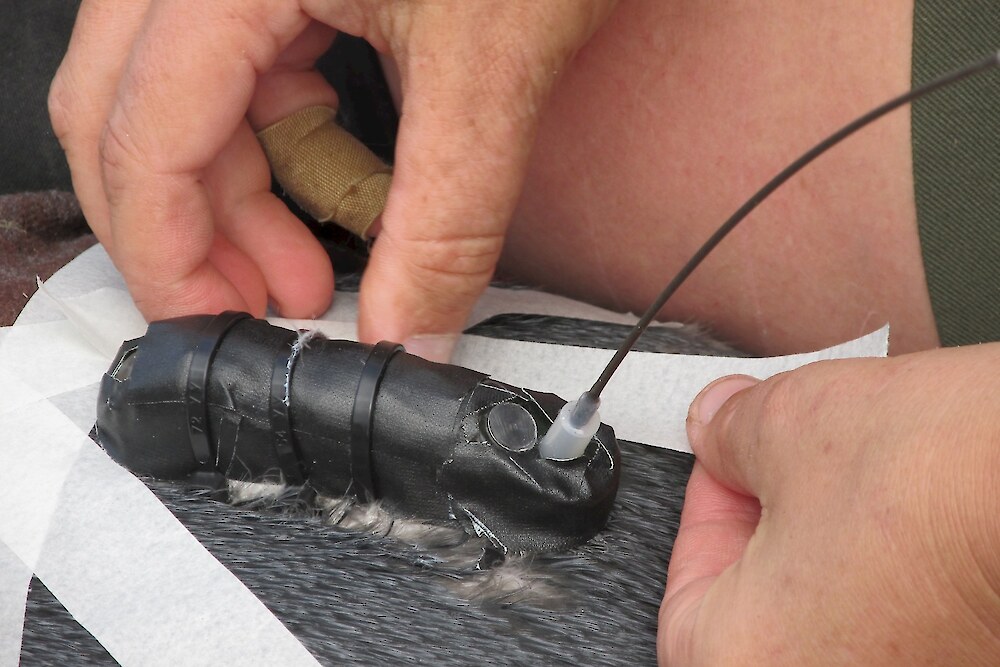
As the transmitters cost a few thousand dollars each, Mel is meticulous in attaching it to the feathers on the penguins back with a combination of very adhesive tape, cable ties, pva glue – it sounds messy, but experience has given Mel the confidence to do a very thorough and tidy job and the finished article sits very neatly on its back. The transmitter is expected to fall off in a few months. After more than half an hour the job is done and the penguin is released to wander back to its nest in the forest undergrowth and await an adult returning from the sea with food.

A second healthy heavy chick was located and fittingly it was nesting in the original John Darby hide at Hina Hina Cove. The same procedure was followed and eventually the team walked up the steep hill back to the 4WD’s and back through the locked access gate and home.

The Southland group consisted of Chris and Brian Rance, Ron and Gay Munro, Peggy Snoep, Lori Johnston and Christine McKenzie and all were inspired by Mel’s passion and skill.

Chris Rance

Yellow-eyed penguin sporting its new transmitter.
The transmitter in place

Posted on: Thursday, 8 March 2018

KiwiBank Predator Free Community Funding

Kiwibank and the Predator Free NZ Trust (PFNZ), have announce a joint program to support communities working on backyard pest control.

The goal is to get a trap in every 5th backyard in towns, suburbs and neighbourhoods in New Zealand!

The next round of funding for the Kiwibank Predator Free Community programme is now open.

Click here to find out more about the program or to apply for funding

Posted on: Thursday, 22 February 2018

Cape to City Conference - Presentations available now

The Cape to City and Poutiri Ao ō Tāne Conference was held 14-16 November in Napier. It included 3 days of excellent presentations, research and discussions about all things pest control and monitoring.

The presentation have now been uploaded on to the Cape to City Website so if you didn’t make it to the conference or you just want to refresh your memory check them out now.

Posted on: Tuesday, 12 December 2017

More Mohua for Eglinton Valley

With mohua breeding well on predator free Anchor Island in Dusky Sound, another 100 birds have been translocated from here to Eglinton Valley early in October. This is the fourth transfer in 7 years, in a joint effort by DOC, the Mohua Charitable Trust and with support from Ngai Tahu. In early 2000’s the mohua population in Eglinton was reduced to 18 due to predator pressure from stoats and rats, while this past autumn 171 were found in the valley. Due to an intensive pest management strategy the area has now become a stronghold for a variety of endangered native species including mohua, long and short-tailed bats, kaka and kakariki. A success story for one of DOC’s Battle for our Birds projects.

Posted on: Saturday, 28 October 2017

Help NIWA fill in the gaps

NIWA need you help.

They are carrying out an investigation into the riparian planting to find out to provide better guidance to the people and groups undertaking stream restoration. They would like to answer such questions as:

  • Is it better to plant a long thin buffer or a short wide buffer?
  • Do wider streams need wider buffers?
  • Do you get better results from planting around the headwaters or further downstream, and does it matter where you plant first?
  • How long will it take to see improvements in water quality, stream life and native terrestrial plants and animals?

For this we need to know about as many projects as possible – where they are located and a few other details about them. You can help by recording a riparian restoration project in our 5-minute survey. The information you enter will go into our National Riparian Restoration Database. We will explore what makes riparian restoration most effective in the next step.

Enter the survey here

Posted on: Thursday, 28 September 2017

Prev page
Page 16 of 30
Next page

© 2026 • Website by RS

Our Supporters

Invercargill City Council Environment Southland Department of Conservation Forest and Bird Southland Community Nursery
  • Home
  • Project Directory
  • Organisations
  • Events
  • News
  • About
  • Links
  • Contact