Update from Mid-Dome Wilding Trees Trust
The Mid Dome Trust finally got a funding boost as announced by the Government on 24 May. While final allocation decisions have yet to be made it is hoped that the Mid Dome programme will have it’s current budget increased by a factor of two or more. That will enable the programme to catch up on two years of severe underfunding and then proceed toward completion by 2033 if optimum funding can be maintained until then.
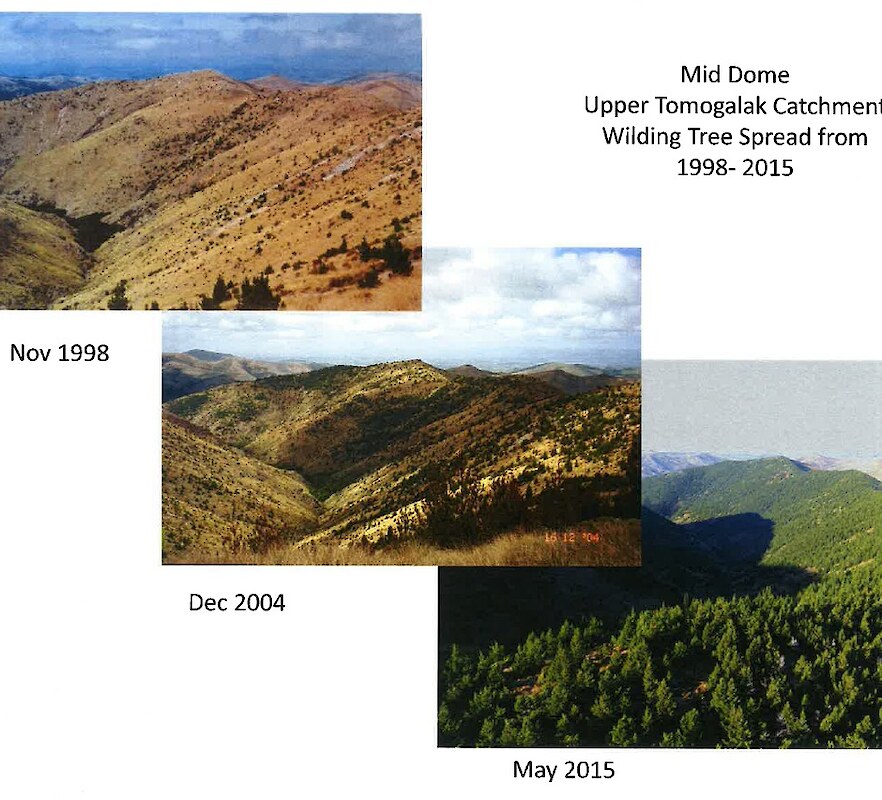
The Mid Dome Trust was formed in August 2006 and will celebrate its 20th anniversary at the Wilding Pine Network Conference in Invercargill on 11 August. It has been a remarkably successful community-led group in Southland. Through a close partnership with Environment Southland, Department of Conservation, Land Information New Zealand and the Ministry of Primary Industries, it has undertaken a highly effective collaborative work programme. Initially this contained the spread of wilding Pinus contorta and P mugo from Mid Dome to an area of 70,000 ha. Initially control was done on scattered spread east of the Mataura River. This allowed management responsibility for any residual risk over 40,000 ha of cleared land to be handed back to the landowners. The next priority was to remove the high-altitude seed sources from the Mid Dome area, including the original soil conservation plantings. Over 1000 ha of dense seed source trees have been sprayed or cut and now the focus is on mopping up the remaining seed sources and taking out any regrowth over an area of 20,000ha. A review of the programme strategy in 2023 showed that it was over halfway to completion. $20 M had been spent achieving this and a similar amount would be needed until 2033 to complete the programme. It is hoped that the latest Government funding and other policy initiatives will allow this to be done. Doing so will protect hundreds of thousands of hectares of land east of Mid Dome in Northern Southland and West Otago from becoming wilding pine forests (a graphic example below). These would prevent pastoral farming, displace native biodiversity, as well as reduce water yield in upper catchments and greatly increase the risk of landscape scale wild fires. Removing this threat will save ratepayers and taxpayers hundreds of millions of dollars in the long term.
The Mid Dome Trust clearly shows how effective local community-based groups can be at taking on even large and very daunting environmental problems. Much of the credit for this at Mid Dome must go to the Trusts Chair Ali Ballantine and her team of dedicated Trustees who have worked tirelessly to stop the wilding spread from there over the last two decades.
Posted on: Saturday, 20 June 2026