Southland Ecological Restoration Network

Southland Ecological Restoration Network

A Network of Southland Community Conservation Projects

  • Home
  • Project Directory
  • Organisations
  • Events
  • News
  • About
  • Links
  • Contact

Events

May • OLGs Bushy Point, Otatara

Past events

SERN Autumn Field Trip - Sandy Point Domain

14 May 2022

The day began at the Oreti Links building with Sheryll Ashton, ICC Parks and Recreation Landscape Planner, explaining that ICC had contracted Boffa Miskell to bring together a Master Plan for Sandy Point for the next 30-50 years and it would be from this that the management plan would develop. Sheryll gave an overview of the Sandy Point area, which encompasses about 2,000ha of land, commenting that it was important to a lot of groups recreationally, as well as having some high ecological values, along with the exotic pine plantations and marram grass, which had been used in the past to enable sand stabilisation. She then asked us to write down our thoughts as to where we would like to see the area going in the future and these notes would be taken back to those pulling together ideas and recommendations for future management. Plenty of discussion followed with over 80 thoughts being noted.

Following lunch we ventured out, firstly to the area opposite the Mountain Bike Car Park. Lloyd Esler spoke about the fungi found here ( an introduced bolete associated with pine), before we walked down along the Oreti River. It was good to see a native remnant, the saltmarsh ribbonwood (Plagianthus divaricatus). Sheryll explained that the current policy for the ICC was to remove the older exotic trees along the river edge over time and replant with natives.

It was then on to the Rover Track, where we had visited on a SERN trip in 2005. At that point pines had been removed not long since and some native plantings had been undertaken, along with natural regeneration being in evidence. There was discussion about the idea of native screen plantings along the track, leaving the areas behind to regenerate naturally over time, with gorse and broom potentially becoming a nurse crop.

A stop at Daffodil Bay gave naturalist, Lloyd Esler the chance to explain that our biodiversity values are not just threatened locally, explaining that the migration of the godwit and other northern hemisphere birds was declining due to alterations to the habitats they stop over at in Korea and China.

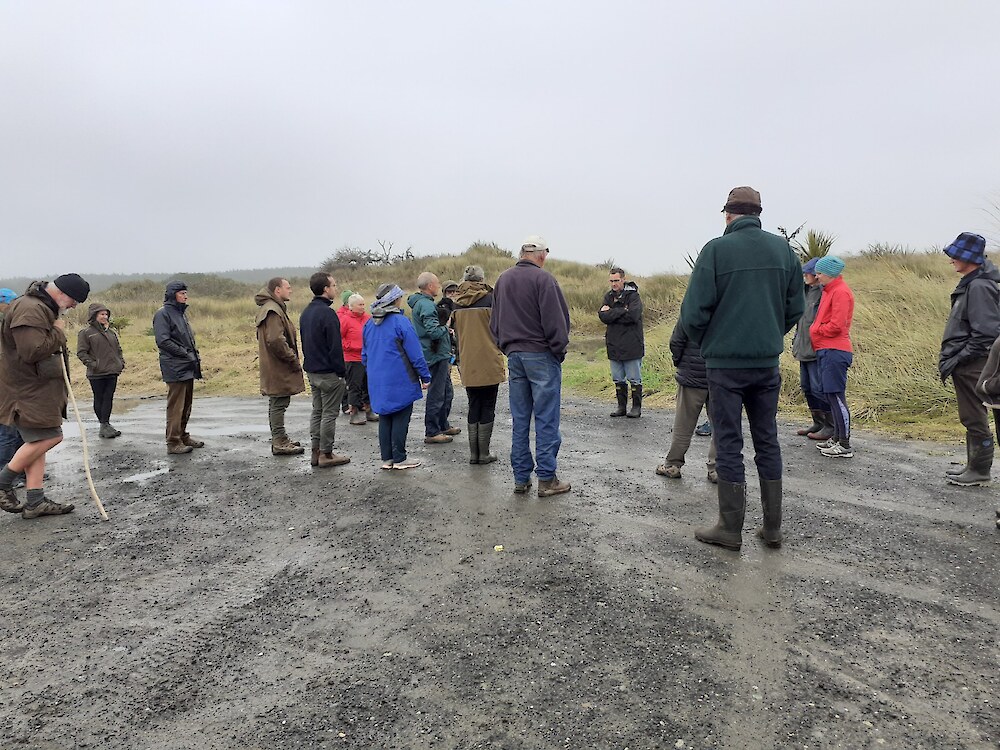
The final stop was at Christies Track, by the Oreti Beach. Here Brian Rance, DOC botanist, described the high value of the Sandy Point area, which had totara forests on sand dunes, a nationally rare ecosystem. Along with that was the dune system and wetland systems, making it a diverse environment. A walk to the beach revealed a specimen of pingao, whether planted or naturally occuring was unknown, however the vision of a section of the dunes beachside being returned to pingao was one many felt worthy of pursuing.

Thanks to Sheryll for her running of the day and to all those who contributed along the way. Also thanks to ICC for the use of the Links building.

Following an overview of Sandy Point management, we divided in to groups to discuss visions for the future.
Sheryll summarised the ideas people put down on the post it notes.
Biodiversity in the form of fungi, this one an exotic bolete fungi that grows in association with pine.
A remnant example of native vegetation along the river side, saltmarsh ribbonwood.
The beginning of the Rover Track. Some native plantings, along with natural regeneration along here.
A site visited in 2005 by a SERN trip, then open, now well enclosed by the native plantings.
Daffodil Bay. Lloyd talks about the birdlife seen here.
Brian Rance, DOC botanist, explaining the high value of the natural ecosystems found throughout Sandy Point.
Sheryll encouraging people to write down their thoughts and ideas.
The Oreti Beach dunes, well modified by the presence of marram grass.
A natural presence of pingao?

Kew Bush Working Bee

4 December 2021

The last Kew Bush Working Bee for this year, with a 9:30am start. We are getting a truck load of dunite gravel delivered that morning and will cart it onto the track by motorbike and trailer. There will be some weeding and planting too.
Please bring shovel or spade, gloves and a wheel barrow if you have one. Check this project out at https://www.sern.org.nz/project-directory/kew-bush-invercargill/

Castledowns Wetland Volunteer day

28 November 2021

This day, starting at 1.30pm, is a follow on from our planting day and a chance for those people who like to get in with cutting tools to attack weeds along the sides of the tracks. If you are happy to pull out Bitter sweet weeds or just want to join us we would love extra help to check the plantings.This well be our last organised day for the 2021 year but feel free to visit at other times.

Please bring afternoon tea and if it is a fine day perhaps a swim in the Oreti and a BBQ afterwards.

For any other details please contact Ann 027 656 9319.

Starter's Guide to Predator Control on Farms - Webinar - with Cam Speedy

9 November 2021

Introduced predators (rats, mice, possums, stoats, ferrets and weasels) create havoc on farms. They eat crops, spread diseases including bovine TB and Leptospirosis, damage equipment, and harm native plants and wildlife. They also breed fast: one pregnant rat can result in 400 more rats in just six months.

Join Cam Speedy, a predator control expert, to learn how predator control can make a significant difference on your land. Knowing when and how is the secret to being successful and keeping the costs down.

The webinar is going to be held on Tuesday 9 November at 7pm.

Brought to you by the Predator Free New Zealand Trust.

2021 SERN Spring Field Day

6 November 2021

The SERN Spring Field Trip headed to the lower Waiau valley where we heard from Mark Sutton of the Waiau Habitat Enhancement Trust about the created wetlands they developed with the purpose of increasing whitebait and eel populations. SERN visited these wetlands in 2008, not long after the start of their creation, however the area of open water has increased fourfold now. From a lookout on Fishing Camp Rd, looking down over the valley there is a mix of wetlands and pasture area. Mark explained that the restoration project will be self sustaining, with income from baleage covering any costs required to maintain the area. With a good road through the wetlands, we were able to drive through the lower area with several stops to look at the ponds and also plantings that had been undertaken. Flax is the main species planted and is done taking large plants from nearby farms, extracting and planting with a digger, so low maintenance. We also looked at a couple of areas where they had done direct drilling of native seeds, in conjunction with DOC. Grass is the main competitor and spraying plots had been tried. They had also experimented with just clearing the area back to dirt with a digger, but still had to spray regrowth. There were several plots of cabbage trees, one which had been smaller plants and required several years of intensive maintenance to get them going. The second plot larger trees had been put in at a higher cost initially, however little maintenance required and so was seen as more effective. The two inlet streams from the Waiau River now maintain good water levels year round, although some of the ponds do dry out through the summer. This provides good areas for wading birds and two bittern had been seen in the area over the last year. Besides providing excellent habitat for eels and whitebait, the main purpose of the wetlands construction, there is also an abundance of waterfowl and other birds in the area.

In the afternoon we visited Broadlands Bush, owned by the Day family. A 12ha podocarp forest remnant on the banks of the Waiau River, protected by a QEII National Trust Open Space Covenant, there are some magnificent 1000 year old totara within, which we walked down to see, accompanied by Warrick Day and his son, Lije. The last stop was Wairaki Oxbow Lagoon, owned by the Smith family. This wetland area still retains its natural character with flax and carex around the edge, while on the escarpment there are remnants of totara. The Waiau Trust is assisting with fencing of the area and some revegetation work. The Smith family are happy for the public to access the wetland and so the Waiau Trust is also helping with the development of tracks to enable this.

Thanks go to the Biodiversity Team, Environment Southland for their support of this field day in covering the bus cost.

Mark Sutton, Waiau Trust, describes the work undertaken to create wetlands near the Waiau River mouth for whitebait and eel habitat.
There are 30 hectares retired from the farm with about half now being open water. Baleage sold from the pasture areas help to cover costs of maintaining the wetland area.
Direct drilling of native seeds (flax, cabbage tree, koromiko, pittosporum, manuka) has been trialled. Here the grass was removed by mechanical means instead of spraying.
An earlier trial with direct drilling of seeds in to grass, with prespraying having been done. Flax and cabbage trees have established the best.
Crossing the ex-DOC bridge over one of the two feeder streams that come from the Waiau River.
The area has had natural regeneration of both rushes and flax around the open water areas. Crack willow has been brought in with floods, however some control work will be done on these. Gorse and broom control is ongoing.
Landowner Warrick Day explained how he purchased Broadlands Bush to protect it. Previously used for stock shelter, the area now has a QEII covenant over it and the understory has come back well over the last decade.
Broadlands Bush is mature podocarp forest with a number of threatened plant species found within it and a good population of native birds.
Lije Day stands in front of one of the many large totara within Broadlands Bush.
QEII Rep, Jesse Bythell describes the forest type and general history of the ecology of the area.
Mark Sutton describes plans for the restoration of the Wairaki Oxbow, here looking north.
Looking south on the oxbow, Broadlands Bush can be seen in the near distance. Remnant totara stand along the escarpment above the oxbow lagoon.
A highlight for the day - the SERN trip attendees gathered under the huge 1,000 year old totara trees in the Day's Broadlands Bush QEII Covenant.
Prev page
Page 16 of 41
Next page

© 2026 • Website by RS

Our Supporters

Invercargill City Council Environment Southland Department of Conservation Forest and Bird Southland Community Nursery
  • Home
  • Project Directory
  • Organisations
  • Events
  • News
  • About
  • Links
  • Contact